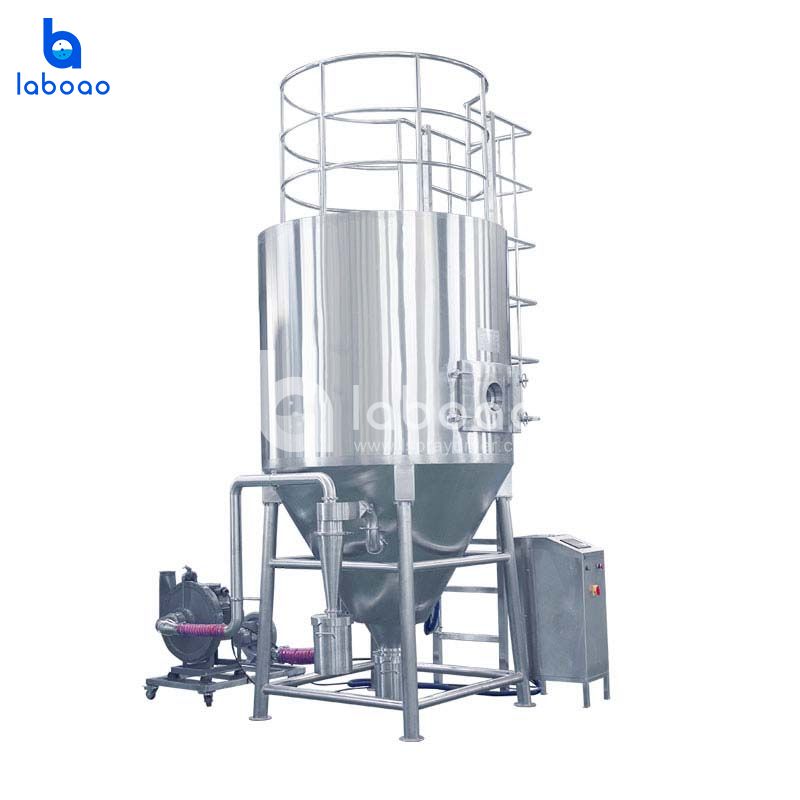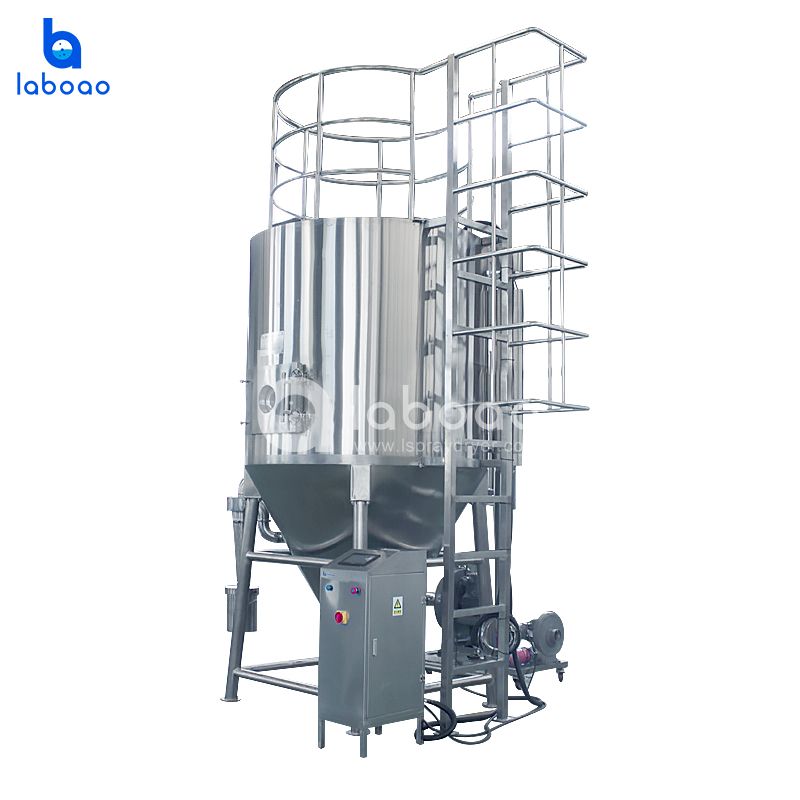
The laboratory-scale spray dryer features a compact, mobile design. It is a self-contained unit that requires no auxiliary facilities; it is ready for immediate use simply by connecting it to a power supply. The system employs PLC control with a touchscreen interface, offering both Chinese and English language options for operation.
I. Scope of Application and Fields:
It is primarily suitable for use in universities, research institutes, and corporate laboratories—spanning industries such as food, biotechnology, beverages, chemicals, materials science, and pharmaceuticals—for R&D and the production of fine particulate powders. It demonstrates broad applicability across various liquid solutions, including emulsions and suspensions. Furthermore, it is ideally suited for drying heat-sensitive substances—such as biological products, biopesticides, and enzyme preparations—because the sprayed material is exposed to high temperatures only during the brief moment it exists as atomized droplets. This instantaneous heating ensures that the active ingredients within the material retain their biological activity after drying. Specific applications include beverages, flavorings and pigments, milk and egg products, plant and vegetable extracts, pharmaceutical synthesis, heat-sensitive plastics, polymers and resins, fragrances, blood products, ceramics and superconductors, biochemical products, dyes, soaps and detergents, food additives, oxides, bone meal, dental powders, and more.
II. Key Features:
1. To ensure sample purity, the unit is equipped with an air inlet filter.
2. The feed rate can be precisely adjusted via a peristaltic pump; the minimum sample volume required is as low as 50 ml. An optional magnetic stirrer is available.
3. The resulting dry powder product exhibits excellent particle size uniformity, with over 95% of the dried powder falling within a consistent particle size range.
4. The laboratory-scale spray dryer features a large, full-color touchscreen interface. It offers a hybrid control mode that combines fully automatic operation with manual control capabilities, includes a ten-segment programmable temperature control system, and features a built-in memory function for storing operational parameters. 5. Manual Control: If process parameters require adjustment during an experiment, the system can be conveniently switched to manual mode. The entire experimental process is dynamically displayed on a color touch screen.
6. Shutdown Protection Function: To shut down, simply press the "Stop" button; the machine immediately ceases operation—with the exception of the fan—ensuring that the heating element is not damaged due to operational errors.
7. The laboratory-scale spray dryer features a built-in, imported, completely oil-free air compressor. This ensures that the resulting powder particles exhibit a normal size distribution and excellent flowability. Furthermore, noise levels are extremely low—less than 60 dB—meeting national laboratory noise standards.
8. Utilizing a two-fluid atomization structure, the entire unit is precision-manufactured from stainless steel. Its compact design requires no auxiliary equipment, making it user-friendly and ensuring it remains in pristine condition even after prolonged use.
9. To accommodate user requirements for adjusting various parameters within the experimental range, the drying temperature control system employs real-time PID constant-temperature technology. This ensures precise temperature regulation across the entire operating range, with a heating control accuracy of ±1°C.
10. The spraying, drying, and collection systems are constructed from transparent, heat-resistant high-borosilicate glass. This ensures that the spray-drying process takes place in a stable, contamination-free environment while allowing for direct visual observation of the entire experiment. This provides researchers with immense convenience in monitoring the experimental progress and results, as well as in promptly identifying and resolving any issues. All glass components are easily detachable and simple to clean.
11. Fully Automatic Control: The system features one-touch startup functionality. Once the spray process parameters are configured and the temperature reaches the preset target, the peristaltic pump automatically activates. The touch screen displays a dynamic animation of the operation, providing a clear visual representation of the workflow. To shut down, simply press the "Stop" button, and the machine executes a safe, automatic shutdown sequence.
12. Specifically designed to handle viscous materials, the laboratory-scale spray dryer is equipped with a nozzle cleaner. If the nozzle becomes clogged, the system automatically clears it; the frequency of the cleaning needle's operation can be automatically adjusted.